
Laser Cutting Is Getting Faster. Is Your Nitrogen Supply Keeping Up?
Index
Introduction: Rising Nitrogen Demand in Modern Laser Cutting
Why Nitrogen Plays a Key Role in Laser Cutting
Nitrogen Consumption in Modern Laser Cutting Machines
Nitrogen Supply Challenges in High-Volume Cutting
The Growing Interest in On-Site Nitrogen Generation
Nitrogen Infrastructure and the Future of Laser Cutting
Final Perspective: Ensuring Reliable Nitrogen Supply for Laser Cutting Operations
A single high-power fiber laser cutting machine can consume up to 50 Nm³ of nitrogen per hour when cutting stainless steel.
In facilities operating multiple laser machines, nitrogen quickly becomes one of the most critical production utilities, alongside electricity and compressed air.
As laser cutting speeds increase and machine power continues to rise, the demand for high-purity nitrogen is growing rapidly across manufacturing environments.
At the same time, India’s metal fabrication sector is expanding alongside industrial development. The Indian metal fabrication market is currently valued at around USD 8–9 billion and is projected to reach approximately USD 11–13 billion by 2030, driven by growth in automotive components, industrial machinery, electrical equipment, and infrastructure development.
Source: Mordor Intelligence – India Metal Fabrication Market Report
With this growth, fiber laser cutting machines are becoming the preferred metal cutting technology because they offer:
high precision cutting
faster processing speeds
improved energy efficiency
reduced maintenance compared to traditional cutting methods
flexibility in processing different metals
However, while the laser itself is the centerpiece of the system, the performance of laser cutting operations also depends heavily on assist gases.
Different gases are used depending on the material and cutting requirements:
Oxygen is typically used for cutting mild steel because it reacts with the metal and increases cutting speed.
Compressed air is sometimes used for thin sheet metals where cost efficiency is more important than perfect edge quality.
Nitrogen, on the other hand, is used when manufacturers require oxide-free cutting and superior surface finish, particularly for materials such as stainless steel and aluminum.
As laser cutting capacity increases across manufacturing facilities, nitrogen demand continues to grow.
This raises an important operational question:
“Is nitrogen supply infrastructure evolving at the same pace as laser cutting technology?”
Why Nitrogen Plays a Key Role in Laser Cutting
Assist gases are essential to the laser cutting process. They help remove molten metal from the cutting zone and influence the final cut quality.
Nitrogen is widely used when manufacturers require clean edges without oxidation.
When nitrogen is used in laser cutting:
oxidation of the cut edge is prevented
the cut surface remains clean and bright
oxide layers that may interfere with coating or welding are eliminated
additional finishing processes are often minimized
Because nitrogen is an inert gas, it does not chemically react with molten metal during cutting.
This makes nitrogen particularly suitable for materials such as:
stainless steel
aluminium
coated metals
galvanized sheets
specialty alloys
Maintaining oxide-free edges is especially important when components undergo painting, powder coating, or welding after the cutting process.
Sources
Trumpf – Laser Cutting Technology Guide
Bystronic – Laser Cutting Handbook
Nitrogen Consumption in Modern Laser Cutting Machines
As fiber laser technology has advanced, nitrogen consumption has increased significantly.
Machine power, cutting speed, nozzle configuration, and material thickness all influence nitrogen demand.
Typical nitrogen consumption ranges include:
3–6 kW fiber lasers: 10–20 Nm³/hr
8–12 kW machines: 20–50 Nm³/hr
higher-power systems: even greater nitrogen flow rates
In manufacturing environments operating multiple laser cutting machines, nitrogen becomes a core production utility.
Reliable nitrogen availability is therefore essential to maintain continuous cutting operations and avoid production interruptions.
Sources
Bystronic Fiber Laser Cutting Data
Trumpf Industrial Laser Systems
Nitrogen Supply Challenges in High-Volume Cutting
As nitrogen demand increases, maintaining a stable supply becomes an operational priority. Many facilities rely on traditional nitrogen supply methods such as high-pressure cylinders or liquid nitrogen storage tanks.
While these supply models are widely used, they introduce several practical considerations.
With cylinder supply, high nitrogen consumption can require frequent cylinder replacements and careful inventory planning to avoid supply interruptions.
Liquid nitrogen systems can support larger volumes of gas demand but require cryogenic storage tanks, periodic refilling, and dependence on external gas deliveries.
For manufacturing environments where laser cutting machines operate continuously, supply planning becomes an important factor in maintaining production stability.
The Growing Interest in On-Site Nitrogen Generation
Because nitrogen consumption continues to grow with the adoption of high-power fiber laser systems, many manufacturing facilities are evaluating on-site nitrogen generation systems.
These systems produce nitrogen directly from compressed air using technologies such as:
On-site nitrogen generators allow facilities to generate nitrogen within the production environment rather than relying entirely on external supply.
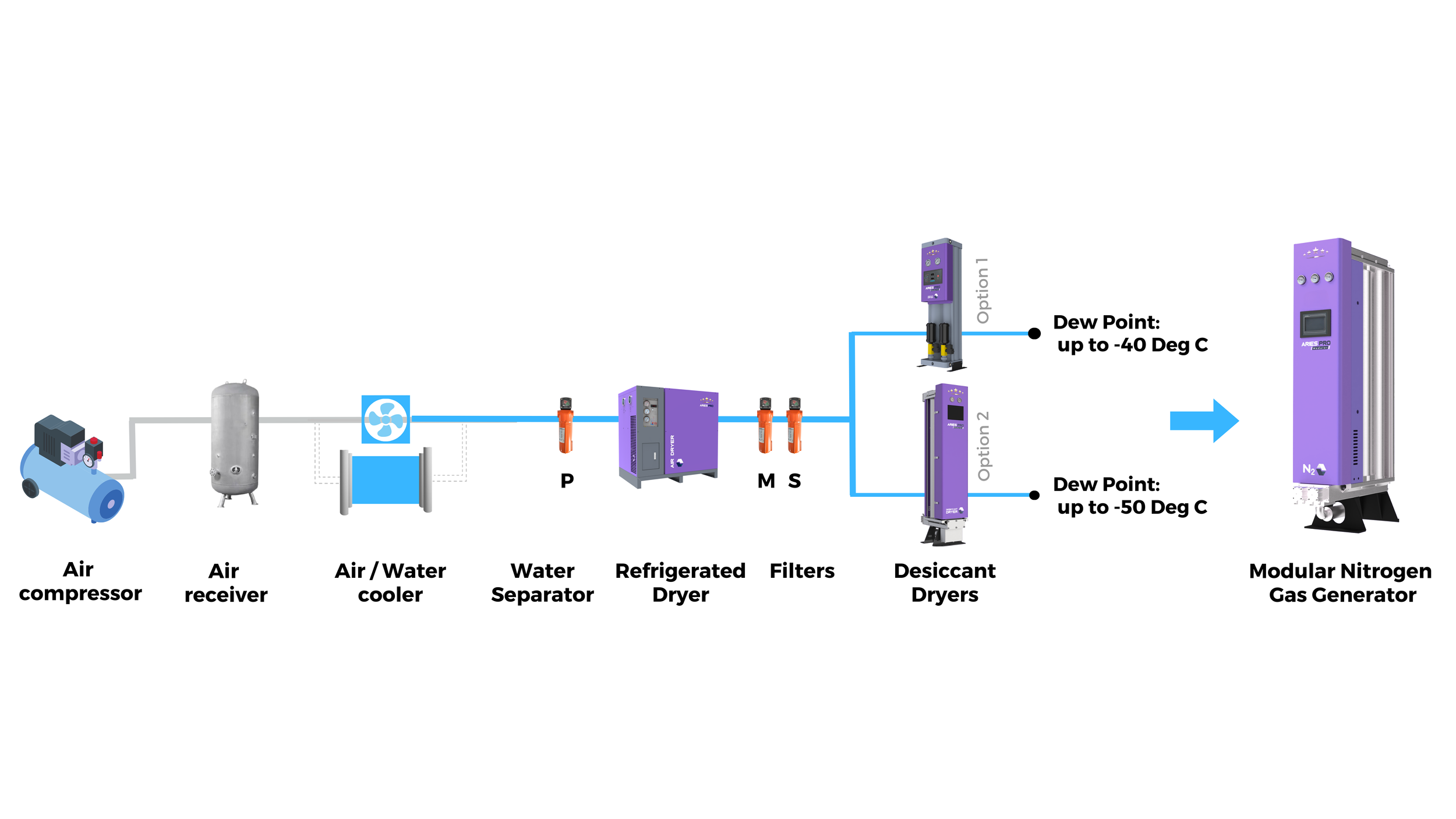
The concept of producing Nitrogen On-Site through PSA Technology
For operations with high nitrogen demand, this approach can offer advantages such as:
continuous nitrogen availability
reduced dependence on supplier deliveries
improved operational control
predictable gas supply during production
As laser cutting technology evolves, nitrogen generation is increasingly becoming part of the supporting infrastructure for modern manufacturing operations.
Nitrogen Infrastructure and the Future of Laser Cutting
Laser cutting machines are becoming faster, more powerful, and more widely used across industrial sectors.
As machine capabilities grow, supporting utilities such as nitrogen supply must also adapt to meet production requirements.
For organizations operating multiple laser cutting machines or high-power fiber lasers, evaluating nitrogen supply strategies can help ensure reliable production performance.
Understanding the differences between cylinder supply, liquid nitrogen storage, and on-site nitrogen generation allows manufacturers to make informed decisions about gas infrastructure.
Final Perspective: Is Your Nitrogen Supply Ready for the Next Generation of Laser Cutting?
Fiber laser cutting technology continues to advance rapidly. Machines are becoming faster, more precise, and capable of higher production throughput.
However, as cutting capacity increases, nitrogen demand rises proportionally.
For fabrication facilities operating multiple laser cutting machines, nitrogen is no longer just a supporting gas—it becomes a critical production utility that directly affects operational continuity.
Relying entirely on external gas supply models such as cylinders or liquid nitrogen can introduce operational challenges as nitrogen consumption grows. Frequent cylinder replacements, supplier delivery schedules, and fluctuating gas demand can all influence production planning in high-volume cutting environments.
Because of this, many manufacturers are beginning to view nitrogen supply not simply as a consumable, but as part of their production infrastructure.
On-site nitrogen generation allows fabrication plants to produce nitrogen directly from compressed air within their facility, providing a gas supply that scales with production requirements.
As laser cutting technology continues to expand across manufacturing sectors, on-site nitrogen generation is increasingly becoming a strategic solution for facilities seeking reliable gas availability and greater operational control.
For manufacturing facilities evaluating nitrogen supply solutions for laser cutting applications, ARIES PRO PSA Technology modular nitrogen generators support reliable nitrogen availability designed for modern industrial metal processing environments.
Connect with an expert to know more about producing nitrogen gas through ARIES PRO modular nitrogen generators!