

Pressure Dew Point vs Atmospheric Dew Point – A Common Industry Misunderstanding
Clear Technical Explanation with Practical Examples
In compressed air systems, dew point is one of the most important parameters for air quality. Yet, it is also one of the most misunderstood. Many engineers, plant managers, and even suppliers use the term “dew point” without clearly distinguishing between pressure dew point and atmospheric dew point.
This misunderstanding often leads to:
Incorrect air dryer selection
Moisture-related equipment failures
Unexpected condensation in pipelines
Increased maintenance and operating costs
Understanding the difference between pressure dew point (PDP) and atmospheric dew point (ADP) is essential for designing a reliable compressed air system.
This blog explains both concepts in simple terms, uses real-world examples, and shows why pressure dew point is the only correct reference for compressed air systems.
Dew Point(Quick Recap)
1) What is Dew Point?
Dew point is the temperature at which air becomes fully saturated with water vapor and moisture begins to condense into liquid water.
In simple words:
Warm air can hold more moisture
Cold air holds less moisture
When air cools to a certain temperature, excess moisture turns into water
That temperature is called the dew point.
2) Why Dew Point Is So Important in Compressed Air?
Compressed air systems always deal with moisture because:
Atmospheric air contains water vapor
Compression concentrates that moisture
Cooling downstream causes condensation
If dew point is not properly controlled:
Water forms inside pipelines
Valves and instruments fail
Corrosion and contamination increase
This is where understanding the type of dew point becomes critical.
Atmospheric Dew Point: What It Really Means
1) Definition of Atmospheric Dew Point
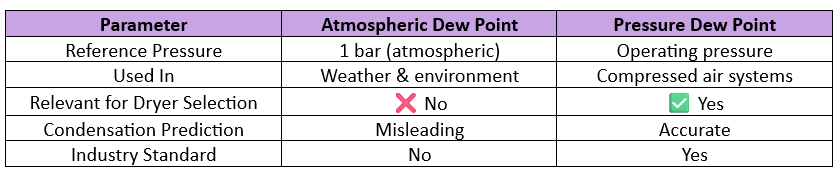
Atmospheric dew point is the temperature at which moisture condenses from air at normal atmospheric pressure (around 1 bar absolute).
This is the dew point:
Reported in weather forecasts
Used in meteorology
Relevant for open air environments
Example: If the atmospheric dew point is 15°C, moisture will condense when ambient air cools below 15°C.
2) Where Atmospheric Dew Point Is Used
Atmospheric dew point is useful for:
Weather prediction
Climate studies
Outdoor environmental analysis
👉 It is NOT suitable for compressed air system design.
Pressure Dew Point: The Correct Reference for Compressed Air
1) Definition of Pressure Dew Point
Pressure dew point (PDP) is the temperature at which moisture condenses from compressed air at its actual operating pressure.
Since compressed air systems operate at elevated pressures (6 bar, 8 bar, 10 bar, etc.), the dew point must be referenced at that pressure.
Pressure dew point tells you:
Whether condensation will occur inside pipes
Whether air is dry enough for the application
Whether the dryer is doing its job
2) Why Pressure Dew Point Is More Important
Compressed air behaves very differently from atmospheric air:
Pressure changes moisture-holding capacity
Cooling effects are more severe
Condensation risks are higher
This is why all air dryer ratings are specified in pressure dew point, not atmospheric dew point.
How Pressure Affects Dew Point – Simple Explanation
When air is compressed:
The same amount of water vapor is now contained in a smaller volume
Relative humidity increases dramatically
Dew point rises under pressure
When compressed air expands or cools:
Moisture condenses quickly
This pressure dependency is the main reason atmospheric dew point values cannot be applied to compressed air systems.
Key Difference Between Pressure Dew Point and Atmospheric Dew Point
Common Industry Misunderstanding Explained
The Mistake
A common mistake is hearing a statement like:
“The dryer delivers -40°C dew point air.”
Without clarification, many assume this means the air will never condense.
But the real question is:
Is that -40°C pressure dew point or -40°C atmospheric dew point?
Why This Matters
A -40°C pressure dew point and a -40°C atmospheric dew point do not represent the same moisture content.
Using the wrong reference can lead to:
Underestimating moisture levels
Selecting the wrong dryer
Unexpected condensation in real operation
Practical Example 1: Refrigerated Dryer Confusion
A refrigerated dryer is rated for:
+3°C pressure dew point
Some users mistakenly assume:
This means air is dry down to +3°C at atmospheric pressure
Reality:
The +3°C value applies only at operating pressure
If air expands or cools further downstream, condensation can still occur
This is why:
Refrigerated dryers are not suitable for cold environments
Outdoor pipelines face moisture problems even with dryers installed
Practical Example 2: Instrument Air Failure
A plant installs a dryer claiming:
“Low dew point air suitable for instruments”
However:
Dew point is quoted at atmospheric pressure
Actual pressure dew point is much higher
Result:
Moisture condenses in control valves
Instruments give unstable readings
Process control becomes unreliable
Correct approach:
Instrument air must be specified and measured in pressure dew point, typically -40°C PDP.
Why Atmospheric Dew Point Is Misleading in Compressed Air
Atmospheric dew point values:
Do not account for compression
Ignore pressure-related moisture behavior
Provide false confidence
This is why relying on atmospheric dew point:
Creates a mismatch between expectation and reality
Leads to moisture problems despite having dryers installed
How Air Dryer Manufacturers Specify Dew Point
Reputable air dryer manufacturers always specify:
Pressure dew point
At a defined operating pressure
At standard inlet conditions
For example:
Refrigerated dryer: +3°C PDP at 7 bar
Desiccant dryer: -40°C PDP at 7 bar
If dew point is quoted without pressure reference, it is incomplete and potentially misleading.
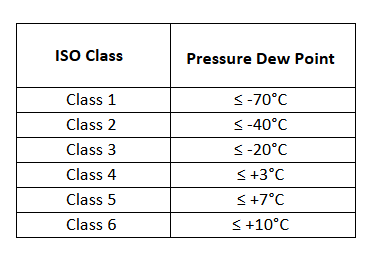
ISO 8573-1: Industry Standard for Dew Point
ISO 8573-1 defines compressed air quality classes based on pressure dew point.
This standard exists specifically to:
Eliminate confusion
Ensure uniform reference
Protect end users
Real-World Scenario: Outdoor Piping Failure
A factory uses compressed air outdoors with a dryer rated at +3°C.
During winter:
Ambient temperature drops to 5°C
Air temperature inside pipelines falls below dew point
Result:
Water condenses
Pipes corrode
Valves malfunction
Mistake:
Assuming +3°C dew point was sufficient
Correct understanding:
Pressure dew point must always be lower than the minimum expected air temperature.
How to Avoid Dew Point Confusion
Always Ask These Questions
Is the dew point specified as pressure dew point?
At what operating pressure is it measured?
What is the minimum ambient temperature?
Is air used indoors or outdoors?
Is it for general use or instrument air?
Measurement of Pressure Dew Point
Pressure dew point is measured using:
Dew point sensors installed in pressurized lines
Sampling systems with pressure control
Atmospheric dew point sensors cannot be directly used for compressed air without correction.
Impact on Energy and Cost
Misunderstanding dew point often leads to:
Over-drying (wasting energy)
Under-drying (causing failures)
Correct pressure dew point selection:
Optimizes energy consumption
Reduces maintenance
Improves system reliability
Why This Misunderstanding Persists
Dew point terminology is not clearly explained
Atmospheric dew point is more commonly known
Marketing literature may oversimplify specifications
Education and clarity are the only solutions.
Final Thoughts
The difference between pressure dew point and atmospheric dew point is not just theoretical — it has direct operational consequences.
Atmospheric dew point is useful for weather, not compressed air
Pressure dew point is the only correct reference for air dryers
Confusing the two leads to condensation, corrosion, and failures
Understanding this distinction allows engineers and plant managers to:
Select the right dryer
Prevent moisture-related damage
Reduce downtime and maintenance costs
In compressed air systems, dew point without pressure context is meaningless.