

What is Dew Point and Why it Matters in Compressed Air Systems?
Compressed air is often called the fourth utility in industries, alongside electricity, water, and gas. It powers tools, controls automation, supports manufacturing processes, and ensures product quality. Yet, one critical aspect of compressed air systems is often misunderstood or ignored - dew point.
Moisture in compressed air can quietly damage equipment, reduce efficiency, contaminate products, and increase operating costs. Understanding what dew point is, how it behaves under pressure, and why it matters in real industrial conditions is essential for selecting the right air dryer and maintaining a reliable compressed air system.
This blog explains dew point in simple terms, connects it to real-world plant conditions, and helps you make better technical decisions.
What Is Dew Point?
Dew point is the temperature at which air becomes fully saturated with water vapor and moisture starts to condense into liquid water.
In simpler terms:
Warm air can hold more moisture
Cold air holds less moisture
When air cools down to a certain temperature, it can no longer retain all the water vapor
The excess moisture turns into liquid droplets — this temperature is called the dew point
For example:
If air has a dew point of 10°C, water will start condensing when the air temperature falls to 10°C or below
Why Dew Point Is Critical in Compressed Air Systems
Atmospheric air always contains moisture. When air is compressed:
Its temperature increases
Its ability to hold moisture changes
Large amounts of water vapor enter the compressed air system
As compressed air cools inside pipelines, receivers, and end-use equipment, moisture condenses and causes multiple problems:
Rust and corrosion in pipelines
Damage to pneumatic tools and valves
Product contamination
Instrument malfunction
Increased maintenance and downtime
This is why dew point is a key performance parameter for air dryers.
Pressure Dew Point vs Atmospheric Dew Point
One of the most common sources of confusion is the difference between atmospheric dew point and pressure dew point.
Atmospheric Dew Point
Measured at normal atmospheric pressure
Used mainly in weather reporting
Not suitable for compressed air systems
Pressure Dew Point (PDP)
Measured at the operating pressure of the compressed air
Relevant for industrial compressed air systems
Determines whether condensation will occur inside pipes and equipment
Always refer to pressure dew point when selecting air dryers.
How Compression Affects Moisture Content
Let’s understand what happens step by step:
Ambient air intake
Atmospheric air contains moisture depending on temperature and relative humidity.Compression stage
Air temperature increases significantly during compression.
Hot air can hold more moisture, so water remains in vapor form initially.Aftercooling and piping
As compressed air cools, its moisture-holding capacity drops.
Water vapor condenses into liquid water.Downstream equipment
Without proper drying, moisture continues to condense wherever temperature drops.
This is why aftercoolers, moisture separators, and air dryers are essential.
What Happens If Dew Point Is Too High?
A high dew point means more moisture in compressed air. This leads to several real-world problems:
1. Corrosion in Pipelines and Equipment
Moisture reacts with metal surfaces causing rust, scale formation, and internal pipe damage. Over time, this reduces pipe diameter and increases pressure drop.
2. Pneumatic Equipment Failure
Moisture washes away lubricants in valves, cylinders, and tools, leading to:
Sticky valves
Seal damage
Reduced equipment life
3. Product Quality Issues
Industries such as:
Food & beverage
Pharmaceuticals
Electronics
Paint and coating
are highly sensitive to moisture. Even small amounts of water can cause spoilage, contamination, or defects.
4. Instrumentation and Control Problems
Moisture affects sensors, actuators, and control air, leading to inaccurate readings and process instability.
5. Increased Maintenance Costs
Frequent breakdowns, part replacement, and unplanned shutdowns increase operating expenses.
Common Dew Point Levels and Their Applications
Different applications require different dew point levels. Selecting the right dryer depends on process sensitivity and ambient conditions.
+3°C Pressure Dew Point
Achieved by refrigerated air dryers
Suitable for:
General manufacturing
Automotive workshops
Packaging
Textile industries
Not suitable for outdoor pipelines in cold regions
-20°C Pressure Dew Point
Achieved by heatless or heated desiccant dryers
Suitable for:
Instrument air
Pneumatic controls
Cold environments
Moderate critical applications
-40°C Pressure Dew Point
Standard for instrument air
Used in:
Chemical plants
Refineries
Power plants
Pharmaceutical production
-70°C Pressure Dew Point
Highly critical applications
Used in:
Electronics manufacturing
Aerospace
Specialty gas applications
Ambient Conditions and Their Impact on Dew Point
Ambient temperature and humidity play a major role in dryer performance
High Humidity Conditions
In tropical regions, inlet air contains high moisture content. This increases:
Energy consumption
Dry Load
Risk of water carryover if the dryer is undersized
High Ambient Temperature
High ambient temperature affects:
Refrigerated dryer efficiency
Condenser performance
Cooling capacity
This is why dryers must be selected considering local climate, not just flow and pressure.
ISO 8573-1 and Dew Point Classification
ISO 8573-1 is the global standard for compressed air quality. For moisture, it defines classes based on pressure dew point:
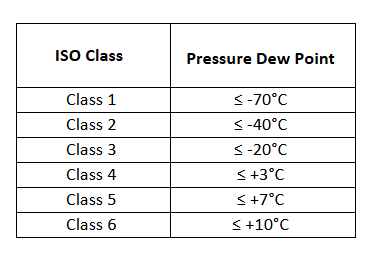
Understanding this standard helps engineers:
Define air quality requirements
Select correct dryers and filters
Avoid overengineering or underperformance
Role of Air Dryers in Dew Point Control
Air dryers remove moisture from compressed air to achieve a specific pressure dew point.
Refrigerated Air Dryers
Cool air to condense moisture
Economical and energy-efficient
Ideal for non-critical applications
Desiccant Air Dryers
Use adsorbent material to remove moisture
Achieve very low dew points
Essential for critical and outdoor applications
Choosing the wrong dryer can result in:
Excess energy costs
Inadequate moisture control
System reliability issues
Real-World Example: Dew Point Failure Scenario
A manufacturing plant installs a refrigerated dryer rated at +3°C PDP. During winter nights, ambient temperature drops to 5°C. Result:
Air temperature inside pipelines falls below dew point
Moisture condenses
Water accumulates in pneumatic lines
Valves malfunction and production stops
The issue is not the dryer quality — it is incorrect dew point selection.
How to Select the Right Dew Point for Your Plant
Ask these key questions:
What is the minimum ambient temperature?
Are pipelines indoors or outdoors?
Is the air used for process, instrumentation, or general tools?
What ISO air quality class is required?
What are the future expansion plans?
A slightly lower dew point than minimum requirement often provides long-term reliability.
Energy Efficiency and Dew Point Optimization
Lower dew point = higher energy consumption.
This is why over-drying should be avoided.
Best practices:
Use refrigerated dryers where possible
Use desiccant dryers only where required
Install proper pre-filters and after-filters
Monitor dew point continuously
Avoid oversizing compressors and dryers
Final Thoughts
Dew point is not just a technical term — it directly impacts system reliability, product quality, energy efficiency, and maintenance costs.
Understanding the difference between atmospheric and pressure dew point, recognizing the influence of ambient conditions, and selecting the right air dryer are crucial steps in building a dependable compressed air system.
A well-designed dew point strategy ensures:
Longer equipment life
Lower downtime
Consistent product quality
Optimized energy usage
In compressed air systems, dry air is not a luxury — it is a necessity.