

Why High-Pressure Compressed Air Is Used in PET Bottle Blowing - And Why Air Quality Matters More Than You Think
Index
Introduction: Why PET Bottling Plants Monitor High-Pressure Compressors
What Actually Happens During the PET Bottle Blowing Process?
Why High Pressure Is Necessary in PET Bottle Blowing?
The Overlooked Reality: Pressure Is Not the Only Variable
What Happens to Air When It Is Compressed
Why Moisture Becomes a Bigger Problem in High-Pressure Systems
Where Air Dryers Come Into the Picture
Lightweight PET Bottles Increase the Sensitivity
Evaluating Your Compressed Air System in PET Plants
Final Perspective
Most PET bottling plants closely monitor their high-pressure compressors. Operators ensure that 30–40 bar pressure is available during bottle blowing, alarms are configured, and capacity is maintained.
But very few stop to ask:
Why is high-pressure compressed air required in the first place?
And even more importantly — is pressure alone enough to guarantee stable bottle formation?
The answer reveals something critical about PET bottle blowing stability:
High pressure forms the bottle.
Air quality determines how consistently it forms.
Let’s understand why.
What Actually Happens During the PET Bottle Blowing Process?
In the PET bottle blowing process (stretch blow moulding), a small preform is transformed into a finished bottle in a matter of seconds.
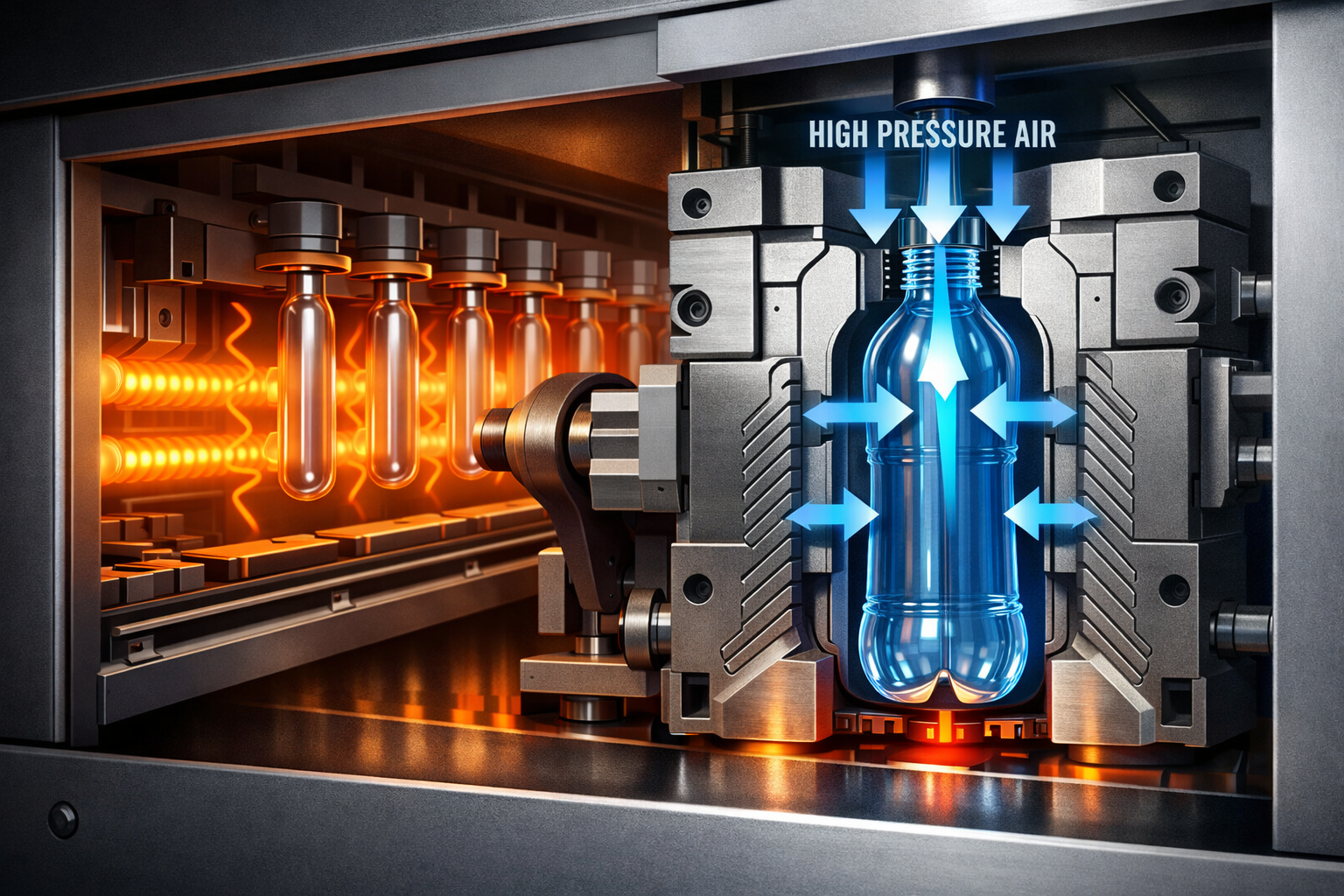
The sequence is simple in concept:
The PET preform is heated to a precise temperature.
A stretch rod elongates it vertically.
High-pressure compressed air expands it outward against the mould cavity.
But in reality, this is a highly controlled mechanical and thermodynamic event. The material must stretch uniformly before cooling begins. The expansion must be fast, even, and complete.
And that is exactly why high-pressure compressed air is used.
Why High Pressure Is Necessary in PET Bottle Blowing
1️⃣ Rapid and Uniform Expansion
PET is a thermoplastic polymer. Once heated, it becomes stretchable — but only within a narrow temperature window.
If the expansion is slow or uneven:
Wall thickness varies
The base becomes weak
Shoulder formation is inconsistent
Structural integrity reduces
High-pressure compressed air ensures rapid outward expansion before the material begins to cool and stiffen.
2️⃣ Structural Strength and Bottle Performance
The final bottle must withstand:
Internal pressure (in some beverages)
Stacking loads during storage
Transportation stress
Uniform material distribution depends heavily on proper pressure application during blowing. Inconsistent pressure delivery can compromise bottle strength.
3️⃣ High-Speed Production Requirements
Modern PET bottling plants operate at extremely high speeds. Cycle times are short, and production targets are aggressive.
Lower pressure would:
Increase cycle time
Reduce throughput
Increase rejection
High pressure enables fast and repeatable forming.
So far, the logic seems simple: higher pressure equals better formation.
But this is only part of the picture.
The Overlooked Reality: Pressure Is Not the Only Variable
Many plants focus only on achieving the required bar level — 30, 35, or 40 bar.
However, high-pressure systems amplify every small inconsistency in the compressed air network.
And that’s where problems begin.
Because compressed air is not just “air.”
It contains moisture, temperature variation, and contaminants unless properly treated.
What Happens to Air When It Is Compressed?
Atmospheric air naturally contains water vapor. When air is compressed:
Its temperature increases
Moisture concentration rises
Relative humidity changes
The risk of condensation increases
If this moisture is not removed before entering the high-pressure stage, it travels through the system.
Under 30–40 bar pressure, even small moisture levels can create operational instability.
Why Moisture Becomes a Bigger Problem in High-Pressure Systems
High-pressure PET blowing systems are sensitive.
Moisture in compressed air can lead to:
Micro pressure instability during expansion
Valve sticking or delayed response
Corrosion in high-pressure pipelines
Reduced seal life
Increased maintenance frequency
In high-speed production, these small disturbances translate into:
Wall thickness variation
Weak bases
Increased rejection rates
Unexpected downtime
And because the system pressure is high, these effects are amplified.
Where Air Dryers Come Into the Picture
This is where air dryers become critical in PET bottling plants.
An air dryer removes moisture from compressed air by reducing its dew point before it enters the distribution system.
In high-pressure PET applications, this ensures that:
Dry air enters the booster stage
Condensation does not occur in high-pressure lines
Valves operate reliably
Pressure stability is maintained
Equipment life improves
Air dryers do not increase pressure.
They protect the quality and consistency of that pressure.
And in bottle blowing, consistency is everything.
Lightweight PET Bottles Increase the Sensitivity
The industry trend toward lightweight PET bottles adds another layer of complexity.
As resin usage decreases:
Wall thickness margins reduce
Tolerance for pressure fluctuation decreases
Material distribution becomes more sensitive
In such conditions, stable and moisture-free compressed air becomes even more important.
What worked in heavier bottles may not work today.
Utility stability is now directly linked to product performance.
Evaluating Your Compressed Air System in PET Plants
If your PET bottling plant is experiencing:
Increased bottle rejection
Base deformation issues
Inconsistent wall distribution
Frequent pneumatic valve maintenance
Pressure fluctuation alerts
It may be time to evaluate:
Dew point levels of compressed air
Air dryer performance
Filter pressure drops
High-pressure air storage capacity
Overall compressed air system design
Often, plants adjust mould temperatures or machine parameters - when the root cause lies in compressed air quality.
Final Perspective
High-pressure compressed air is essential in PET bottle blowing because it provides the force required for rapid and uniform expansion of the heated preform.
But pressure alone does not define stability.
Moisture-free, properly treated compressed air ensures that high-pressure systems operate consistently, protect equipment, and maintain bottle quality across every production cycle. Even small variations in air quality can influence valve performance, moulding stability, and bottle strength—especially in modern high-speed bottling lines.
In PET bottling plants:
Pressure forms the bottle.
Air quality protects the process.
Reliable compressed air treatment systems, including high-performance desiccant air dryers, play a crucial role in maintaining this stability. ARIES PRO air dryers are designed to support high-pressure PET bottling plants where dry, consistent compressed air is essential for stable stretch blow moulding operations.
For more information about ARIES PRO air drying solutions for PET bottling applications, connect with our team to learn how the right air treatment system supports consistent bottle production.