

The Invisible Enemy in Food Packaging: How Oxygen Affects Shelf Life
Index
1. Introduction: The Invisible Enemy in Food Packaging
2. Why Oxygen Is a Problem in Packaged Foods
3. Lipid Oxidation: The Science Behind Rancidity
4. Oxygen and Microbial Activity
5. Nutrient Degradation Caused by Oxygen
6. Texture and Freshness Loss
7. How the Food Industry Controls Oxygen
8. Nitrogen in Modern Food Packaging
9. Role of Nitrogen Generation in Packaging Operations
10. Conclusion: Controlling Oxygen to Improve Shelf Life
Food packaging plays a critical role in maintaining product quality from the factory to the consumer’s table. While packaging materials and sealing technologies receive significant attention, there is another factor that has a major impact on food stability — oxygen.
Oxygen is naturally present in the air around us, but in packaged food products it can become one of the biggest contributors to quality deterioration. From flavor changes to nutrient loss, oxygen exposure can significantly reduce the shelf life of many packaged foods.
Because of this, controlling oxygen inside food packages has become a key focus in modern food processing and packaging systems.
Why Oxygen Is a Problem in Packaged Foods
Many packaged food products — especially snack foods, nuts, fried products, and bakery items — contain fats, oils, and sensitive nutrients that react with oxygen.
When oxygen enters a sealed package, it can trigger several chemical and biological reactions that gradually affect the quality of the product.
These reactions often happen slowly, which is why packaged foods may appear stable initially but deteriorate over time.
Food manufacturers therefore work carefully to reduce oxygen levels inside packaging environments.
Lipid Oxidation: The Science Behind Rancidity
One of the most well-known reactions caused by oxygen is lipid oxidation.
Many snack foods contain unsaturated fats that react with oxygen molecules. This reaction produces compounds such as peroxides and aldehydes that can lead to:
rancid taste
unpleasant odor
degradation of flavor
reduced nutritional value
Scientific studies show that even small amounts of oxygen present inside packaging headspace can initiate oxidation reactions.
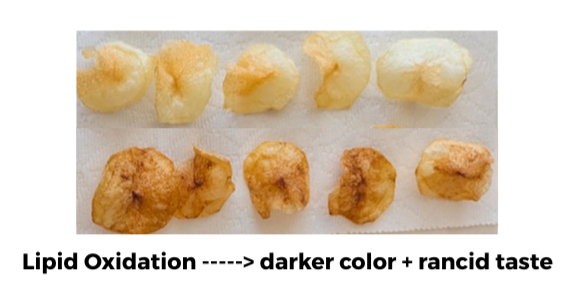
Over time, these reactions gradually degrade the food product and shorten its shelf life.
Source: Frankel, E.N., Lipid Oxidation – Journal of Oleo Science
Oxygen and Microbial Activity
Oxygen can also support the growth of certain microorganisms.
Although many snack foods have low moisture levels, oxygen exposure can still influence microbial activity in certain packaged food environments such as:
bakery products
nuts and seeds
processed dry foods
Some aerobic bacteria and molds require oxygen to grow. Reducing oxygen levels inside packaging therefore helps limit microbial growth and contributes to longer shelf life.
Source: Food Microbiology – Elsevier Publications
Nutrient Degradation Caused by Oxygen
Oxygen exposure can also affect important nutrients in food.
Certain vitamins, particularly vitamins A, C, and E, are sensitive to oxidation. When these nutrients react with oxygen, they gradually degrade over time.
This means that oxygen exposure can not only affect flavor and aroma but may also reduce the nutritional value of packaged foods.
In addition, oxygen can cause changes in color and appearance, which may influence consumer perception of product freshness.
Source: Food Chemistry Journal
Texture and Freshness Loss
In snack foods, maintaining texture is just as important as maintaining flavor.
Fried snacks, extruded products, and chips are particularly sensitive to oxidation reactions. As oxygen reacts with fats in these products, it can lead to changes in taste and texture.
This is why food manufacturers often focus on maintaining controlled atmospheres inside packaging to protect product quality during storage and transportation.
How the Food Industry Controls Oxygen
Because oxygen can affect flavor, nutrients, and microbial stability, food manufacturers use several techniques to reduce oxygen inside packaging.
Common approaches include:
vacuum packaging
oxygen absorbers
modified atmosphere packaging
nitrogen flushing
Among these methods, nitrogen flushing has become one of the most widely used solutions in snack food packaging.
Nitrogen is an inert gas that does not react with food components. When nitrogen replaces oxygen inside the package, it helps create a protective atmosphere around the product.
This significantly slows oxidation reactions and helps maintain product quality throughout the distribution process.
Nitrogen flushing is commonly used in packaging applications such as:
potato chips
fried snacks and namkeen
nuts and seeds
coffee products
spices
Nitrogen in Modern Food Packaging
In modern food packaging systems, nitrogen is introduced into the package before sealing. This process displaces oxygen and creates an environment that helps protect the food product.
By reducing oxygen levels, nitrogen helps:
slow lipid oxidation
maintain flavor stability
protect product texture
extend shelf life
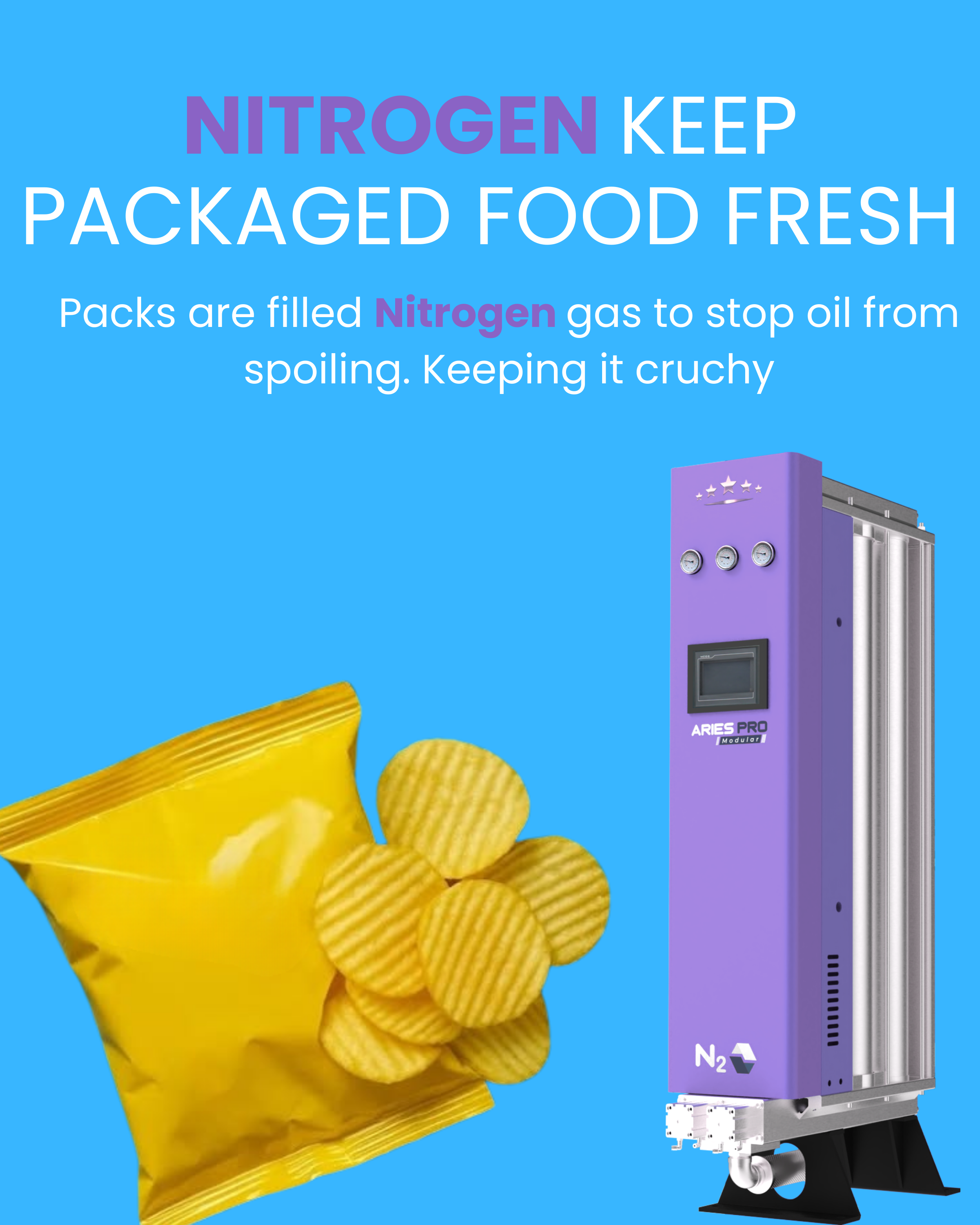
ARIES PRO MODULAR NITROGEN GENERATOR
As food production volumes grow and packaging lines operate at higher speeds, many manufacturers are also evaluating on-site nitrogen generation systems to ensure consistent gas availability during packaging operations.
This approach allows plants to generate nitrogen directly within the facility rather than relying entirely on external gas supply.
Oxygen may be invisible, but its impact on packaged food quality is significant. From lipid oxidation to nutrient degradation, oxygen exposure plays a major role in determining the shelf life of many food products.
For food manufacturers, controlling oxygen inside packaging environments is therefore an important step in maintaining product stability and consistent product quality throughout storage and distribution.
Technologies such as nitrogen flushing and controlled packaging atmospheres help reduce oxygen levels inside packages, slowing oxidation reactions and helping preserve flavor, texture, and freshness.
For packaging facilities that require a reliable nitrogen supply, ARIES PRO offers industrial modular nitrogen generators that support continuous nitrogen availability for modern food packaging operations. These systems help manufacturers maintain stable gas supply for processes such as nitrogen flushing and modified atmosphere packaging.
Manufacturers looking to better control oxygen exposure in packaged foods can benefit from understanding how ARIES PRO modular nitrogen generation systems support consistent packaging environments and improved shelf life.
Connect with ARIES PRO Experts!