

Refrigerated vs Desiccant Dryers: Dew Point Comparison and Selection Guide
Understanding 3°C, -20°C, and -40°C Dew Points with Applications
Moisture is one of the biggest hidden enemies in compressed air systems. While air compressors generate the required pressure and flow, it is the air dryer that determines the final air quality reaching the process.
Two dryer technologies dominate industrial compressed air systems:
Refrigerated air dryers
Desiccant air dryers
The most common confusion arises around dew point levels - especially 3°C, -20°C, and -40°C. Many users either under-spec their dryer (leading to failures) or over-spec it (leading to high energy costs).
This guide explains the difference between refrigerated and desiccant dryers, compares their dew point capabilities, and helps you select the right dryer based on real applications.
Why Dew Point Matters in Dryer Selection
Dew point is the temperature at which moisture starts condensing from compressed air. If compressed air temperature drops below its pressure dew point, water forms inside pipelines and equipment.
Key impacts of improper dew point selection:
Corrosion in air lines
Valve sticking and seal damage
Instrument failure
Product contamination
Increased maintenance and downtime
The dryer’s role is to control dew point so condensation never occurs in actual operating conditions.
Understanding the Two Dryer Technologies
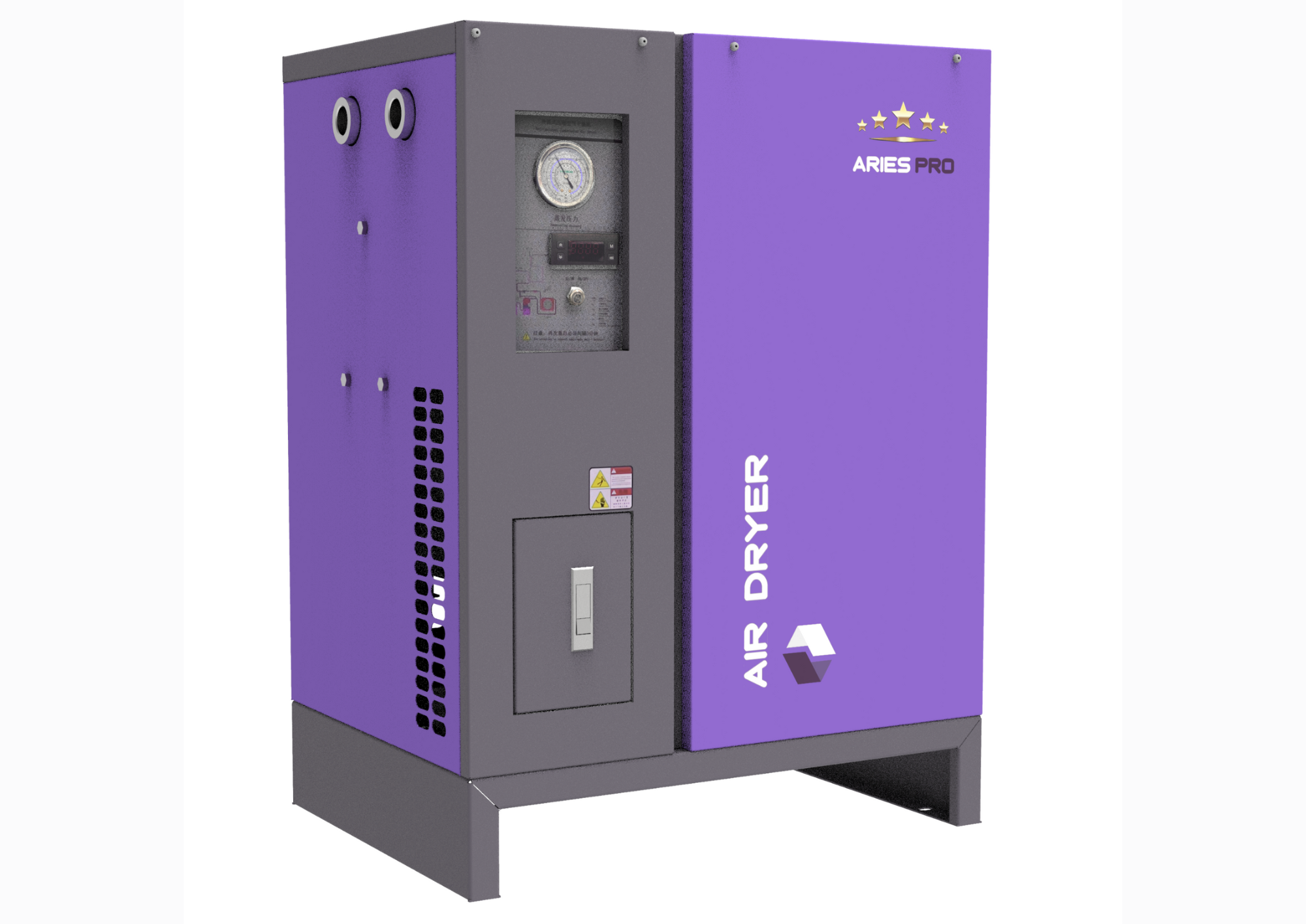
AriesPro Refrigerated Air Dryer
16 Bar Pressure | 3° to 7° Dew Point | Plate type
Refrigerated dryers work by cooling compressed air to around +3°C, causing moisture to condense. The condensed water is separated and drained, and the dry air is reheated slightly before use.
Key characteristics:
Achieves +3°C pressure dew point
Simple design
Low operating cost
Ideal for general industrial use
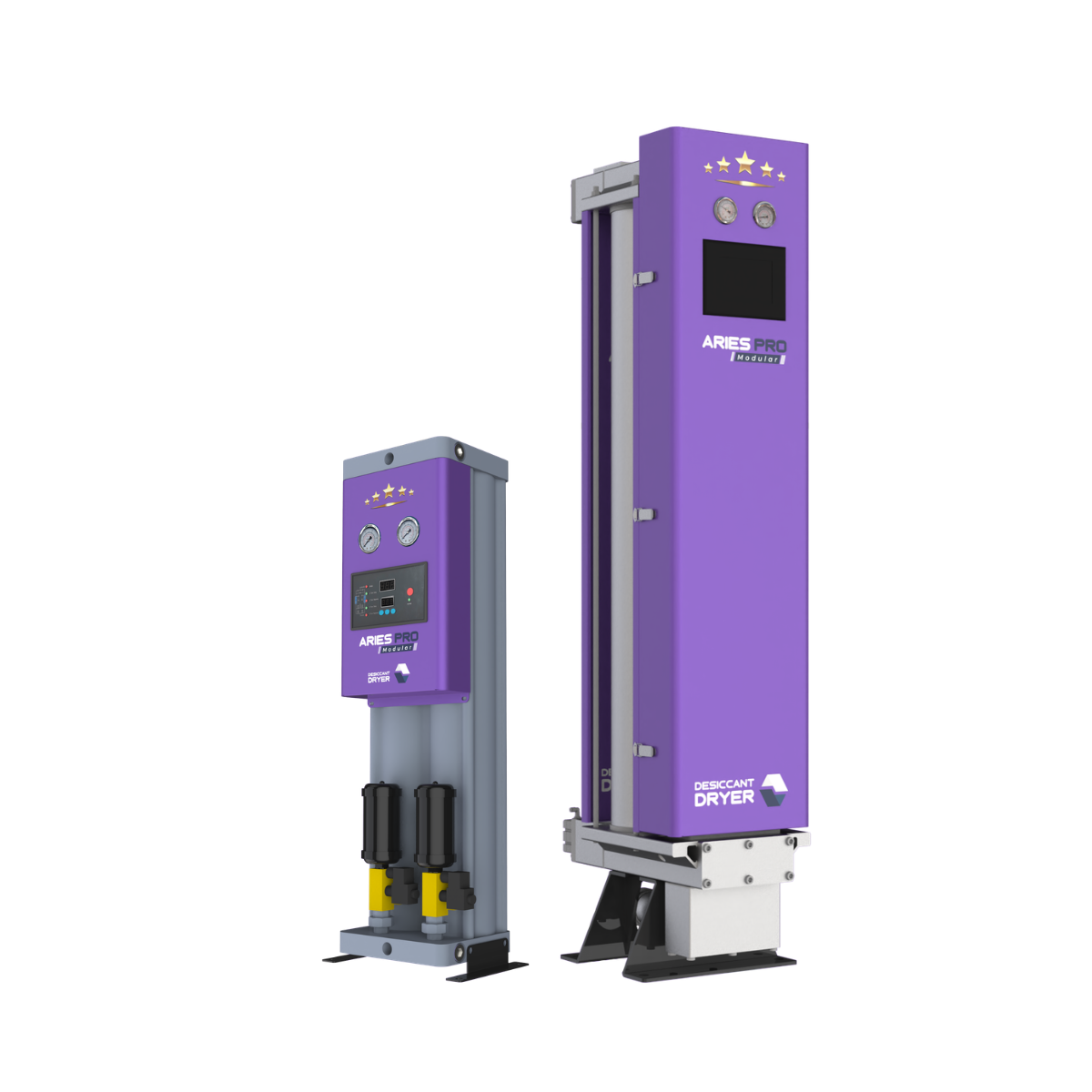
AriesPro Desiccant Air Dryer
10 & 16 Bar Pressure | Upto -50° Dew Point
Desiccant dryers remove moisture by adsorption, using materials like activated alumina or molecular sieve. These dryers can achieve very low dew points, regardless of ambient temperature.
Key characteristics:
Achieves -20°C, -40°C, or even -70°C
Used for critical applications
Higher energy consumption
More complex operation
Dew Point Levels Explained: 3°C, -20°C, and -40°C
Understanding these dew points is critical to selecting the right dryer.
3°C Dew Point – Refrigerated Dryer Applications
What Does +3°C Dew Point Mean?
A +3°C pressure dew point means:
Moisture will not condense as long as air temperature stays above 3°C
Suitable for indoor applications with controlled temperatures
Typical Applications
Automotive workshops
General manufacturing
Packaging lines
Plastic molding
Textile industries
Assembly plants
Advantages of 3°C Dew Point
Lowest energy consumption
Simple maintenance
Compact design
Lower capital cost
Limitations
Not suitable for:
Outdoor pipelines
Cold climates
Instrument air
Precision manufacturing
If ambient temperature drops below 3°C, condensation will occur.
-20°C Dew Point – Medium-Critical Applications
What Does -20°C Dew Point Mean?
A -20°C pressure dew point provides a significantly higher safety margin against condensation. Even if air temperature drops close to freezing, moisture will not condense.
Dryer Type
Heatless desiccant dryer
Blower purge desiccant dryer
Typical Applications
Instrument air (non-critical)
Pneumatic control systems
Paint booths
Cold storage facilities
Outdoor compressed air lines
Advantages
Better moisture protection
Suitable for varying ambient conditions
Reliable for process control air
Considerations
Higher energy consumption than refrigerated dryers
Requires proper pre-filtration
Periodic desiccant replacement
-40°C Dew Point – Critical and Instrument Air
What Does -40°C Dew Point Mean?
A -40°C dew point ensures extremely dry air, eliminating moisture-related risks even in harsh environments. This is the standard requirement for instrument air in many industries.
Dryer Type
Heatless desiccant dryer
Heated desiccant dryer
Heat of compression (HOC) dryer
Typical Applications
Refineries and petrochemical plants
Chemical processing
Pharmaceutical manufacturing
Power plants
Electronics and semiconductor industries
Advantages
Maximum protection against moisture
Ensures stable instrument performance
Prevents freezing in valves and actuators
Trade-Offs
Higher capital cost
Higher operating energy
Requires skilled maintenance
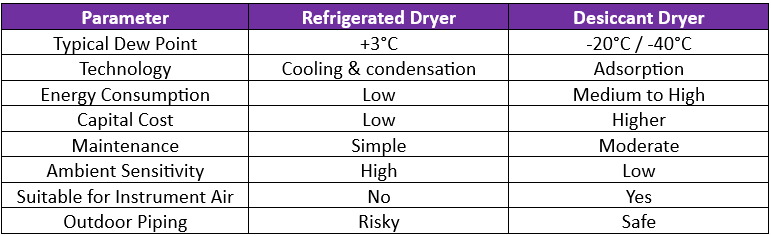
Refrigerated vs Desiccant Dryers - Side-by-Side Comparison
Common Selection Mistakes (and How to Avoid Them)
Mistake 1: Selecting a Dryer Based Only on Flow Rate
Flow rate is important, but dew point requirement is more critical.
Mistake 2: Ignoring Ambient Temperature
In tropical climates, moisture load is high. In cold climates, condensation risk increases.
Mistake 3: Over-Drying the Air
Using a -40°C dryer where +3°C is sufficient wastes energy and increases operating costs.
Mistake 4: No Future Expansion Consideration
Future plant expansion may require better air quality.
ISO 8573-1 and Dew Point Classes
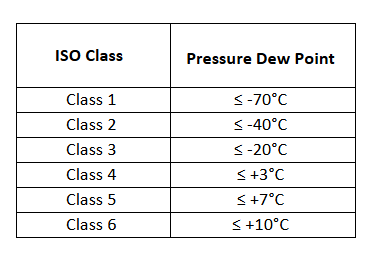
Matching ISO class to application ensures compliance and consistency.
Energy Efficiency Considerations
Energy consumption increases sharply as dew point requirement becomes lower.
Best practices:
Use refrigerated dryers wherever possible
Use desiccant dryers only where technically required
Maintain filters to avoid pressure drop
Monitor dew point continuously
Avoid oversized dryers
Real-World Example
A packaging plant installed a -40°C desiccant dryer for general pneumatic tools.
Result:
No improvement in product quality
Increased power consumption
Higher maintenance costs
After replacing with a +3°C refrigerated dryer:
Same performance
Lower energy cost
Faster ROI
Correct dew point selection is more important than “better” technology.
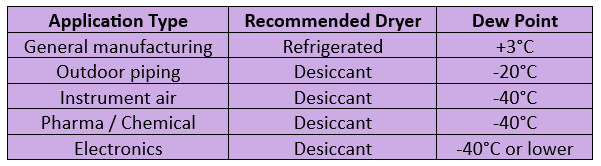
How to Choose the Right Dryer – Quick Guide
Final Thoughts
There is no “one-size-fits-all” solution when it comes to air dryers.
Refrigerated dryers are economical, efficient, and ideal for most industrial applications.
Desiccant dryers are essential where moisture control is critical and environmental conditions are challenging.
Understanding dew point levels, application needs, and ambient conditions allows you to select the right dryer — ensuring system reliability, energy efficiency, and long equipment life.
In compressed air systems, the right dew point is not about being the lowest - it’s about being correct.